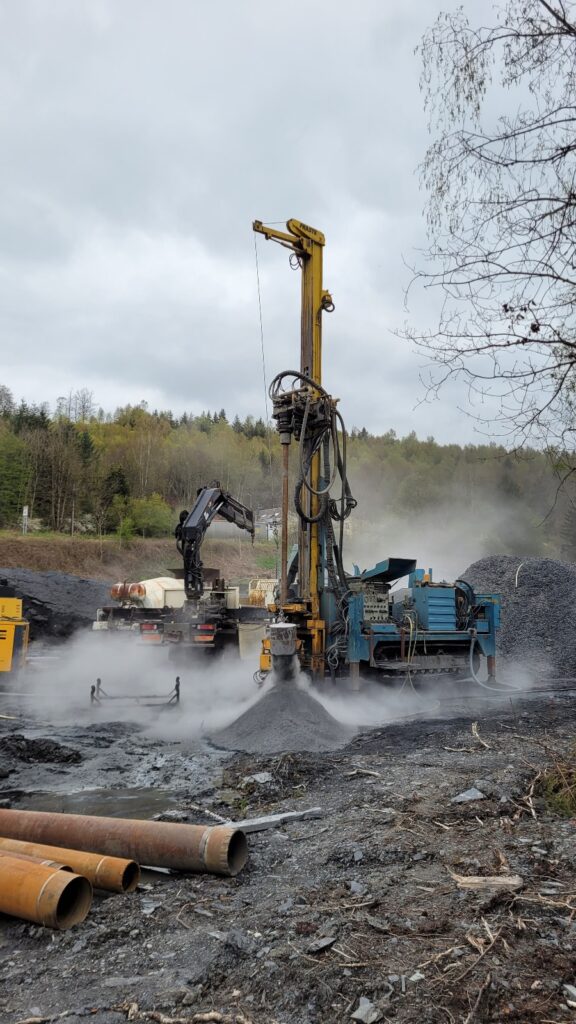
The energy transition requires solutions that can store vast amounts of clean energy not just for hours, but for entire seasons. In Martelange, Belgium, the WeForming project is demonstrating a pioneering solution: combining an innovative Carnot Battery with seasonal energy storage in abandoned slate mines.
The project’s vision, captured by its core benefit, is to Provide Cost-Effective Solution to the Long-Term Thermal Energy Storage.
The Story: Converting Mines into Massive Batteries
The Martelange demonstrator focuses on an interactive residential district. The key developments are the underground seasonal storage system and the Carnot battery itself.
- Seasonal Storage: In the summer months, excess solar energy is converted into heat and stored in underground reservoirs—specifically, a massive 6,500 cubic metres of water in abandoned slate mines.
- Year-Round Heat: This hot water (ranging from 30°C to 50°C) is then used to provide heat to buildings during the cold winter months.
- The Energy Hub: The Carnot Battery acts as the energy hub, allowing for the conversion of stored thermal energy back into electricity when needed, while also supporting the local grid.
The system is designed to supply 200 buildings in the district.
“The Martelange demonstrator will allow us to test a Carnot battery and seasonal thermal storage, which can reduce our reliance on fossil energy while providing flexibility services to the local grid, proving that a residential district can be both energy-efficient and a valuable contributor to grid stability.”
Frédéric Ransy (Project Technical Lead at Wingest)

Innovation in Action: The Largest Carnot Battery
The core technology is the Carnot Battery demonstrator, combining a heat pump and an Organic Rankine Cycle (ORC). At 50 kW of electricity and 500 kW of thermal power, it is currently the largest of its kind under construction in the world.
How it Works (Simplified): The Carnot battery is a system able to convert electricity into heat, and heat back into electricity, allowing it to act as an energy hub. It absorbs renewable energies when available and provides heat or electricity when needed.
Digital Twins: To manage this complex system, the demo uses Digital Twins—virtual replicas—for the Carnot battery components (like the heat exchanger and pump) and the entire system (buildings, underground storage, etc.). These models ensure efficient operation before the system is run in the real world.
Coordination: An AI-based optimizer and a cloud-based platform coordinate the battery and all local energy systems, guaranteeing residents stay comfortable and that reliance on fossil fuels is dramatically reduced.
The Belgian demo, led by Wingest and with support from the University of Liège and Flexide Energy, is proving that even complex residential districts can be a valuable contributor to grid stability while achieving profound energy efficiency.